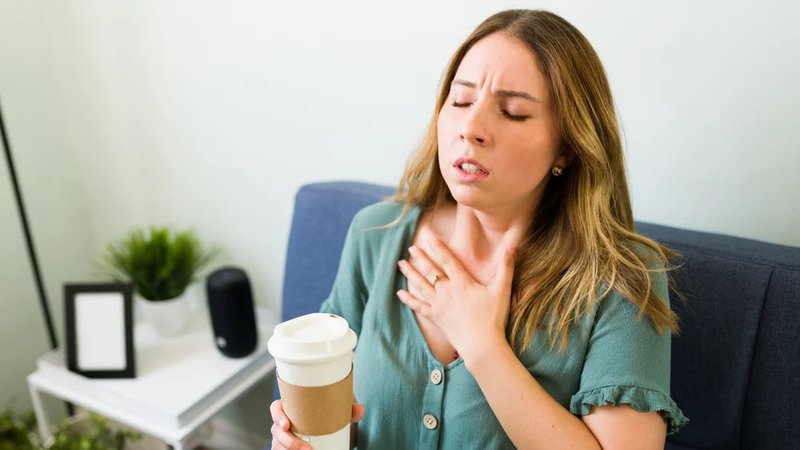
My left eyelid started twitching in the spring of 2017. I was twenty‑eight, working as a Q Grader, tasting upwards of two hundred coffees a week. The twitch came and went. I’d feel it during afternoon cuppings, a small flutter under my eye, like a moth trapped behind my skin. I’d rub my eyelid with the heel of my hand and keep going. The coffee didn’t stop. Neither did the twitch.
Then came the heart palpitations.
Not the dramatic kind. No chest pain, no shortness of breath. Just a single skip, a pause, then a thud. Like someone had tapped my sternum from the inside. They happened most often in the late afternoon, when the caffeine was still high but the workday was winding down. I’d be driving home on I‑5, the sun low over the Olympic Mountains, and my heart would do its little skip. I’d grip the steering wheel harder. Breathe. Count the next ten beats. Normal. Keep driving.
I didn’t see a doctor. I didn’t stop drinking coffee. I just added anxiety to my caffeine intake, and caffeine to my anxiety. The feedback loop was invisible to me at the time.
The Caffeine Calculator would have told me I was near the upper limit.
Caffeine Calculator
Track your daily caffeine intake against the FDA 400mg limit.
All data stays in your browser — we never see it.
I remember the day it clicked. I was sitting in a lecture hall at Washington State University, listening to a professor talk about the pharmacokinetics of stimulants. He put up a slide: “Adverse effects of caffeine at different doses.” At 200 mg, increased alertness. At 400 mg, nervousness and jitteriness. At 600 mg, tachycardia and anxiety. At 1,000 mg, severe arrhythmias and seizures.
I looked down at my notebook. I had logged 450 mg that day.
The nervousness and jitteriness slide was aimed directly at me.
The Half‑Life Tracker can help you see where you are on that curve.
The relationship between caffeine and anxiety is not straightforward. For some people, 200 mg is fine. For others, 50 mg is too much. The difference is partly genetic—CYP1A2 again—but also psychological. If you’re already prone to anxiety, caffeine lowers the threshold for a panic attack. It’s not that caffeine causes anxiety. It’s that caffeine loosens the latch on the door.
I learned this from a client named Maya. She was twenty‑three, a graduate student in psychology, drinking about 300 mg a day. She came to me because she was having panic attacks in the library. Not during exams. Just… sitting there, studying, her heart would start racing, her hands would go cold, she’d have to leave and sit on the bathroom floor until it passed.
Her doctor had ruled out heart problems. Her therapist thought it was stress. Maya thought it was caffeine.
We did an experiment. Week one, she cut her intake to 150 mg. The panic attacks decreased but didn’t disappear. Week two, she cut to 50 mg. They stopped. Week three, she went back to 300 mg. They returned by the third day.
“I’m not anxious,” she told me. “My body is anxious. The caffeine makes my body anxious, and then my brain tries to find a reason.”
She quit caffeine entirely after that. Six months later, she was drinking decaf and sleeping through the night.
The Sleep Estimator can show you the connection between caffeine and your nervous system.
Sleep Estimator
Get your personal caffeine cutoff time for better sleep.
All data stays in your browser — we never see it.
I’ve done my own experiments. I’ve tracked my anxiety on a scale of 1 to 10, correlated with caffeine intake, over two months. The data was messy. Some days, 200 mg felt fine. Other days, 150 mg made me jittery. The difference seemed to track with sleep, stress, and whether I’d eaten enough breakfast. But the overall trend was clear: above 300 mg, my baseline anxiety rose. Above 400 mg, I was on edge.
At 500 mg, I was a mess. My hands trembled. My thoughts raced. I couldn’t sit still. I drank a lot of water. I paced my apartment. Espresso watched me from the windowsill, unimpressed.
The threshold for anxiety is lower than the threshold for cardiac toxicity. You can feel anxious on 200 mg. You might not feel cardiac symptoms until 600 mg. That means you can be suffering without being in danger. It doesn’t make the suffering less real.
I remember one night in particular. I’d had a large cold brew at 2 PM—probably 300 mg on top of my morning coffee. By 6 PM, I was pacing. By 7 PM, I was convinced I had a brain tumor. By 8 PM, I was googling symptoms. By 9 PM, I was lying on the floor, staring at the ceiling, trying to slow my breathing.
Sam came home at 9:30. She found me on the living room rug, Espresso sitting on my chest, purring.
“What happened?” she asked.
“Caffeine,” I said.
She didn’t say “I told you so.” She made me a cup of chamomile tea and sat on the floor with me until my heart rate came down.
The Half‑Life Tracker can’t predict anxiety. But it can show you how much caffeine is in your system at any given time. If you’re feeling anxious in the afternoon, check the tracker. You might find that you’re still carrying 100 mg from your morning coffee.
Anxiety is not a failure. It’s a signal. Caffeine amplifies the signal. If the signal is already loud, caffeine can make it unbearable.
A friend of mine, a neuroscientist at UW, once told me that caffeine is like turning up the gain on a microphone. The background noise gets louder too. If your background noise is low, all you get is a clearer signal. If your background noise is high, you get feedback.
I think about that every time I pour my second cup.
I’m down to two cups a day now. One in the morning, one before noon. No afternoon coffee. No cold brew after 1 PM. My eyelid stopped twitching years ago. My heart still skips sometimes—less often, not never—but I’ve learned not to google the symptoms.
The Caffeine Calculator helped me find my limit.
Caffeine Calculator
Track your daily caffeine intake against the FDA 400mg limit.
All data stays in your browser — we never see it.
If you’re feeling anxious, and you drink caffeine, try cutting your intake in half for a week. Don’t quit cold turkey—the withdrawal headache is real—but reduce. See what happens. You might find that the anxious feeling wasn’t coming from nowhere. It was coming from the coffee.
I still drink coffee. I still love the ritual. The grind, the bloom, the pour. But I’ve learned to stop at two cups. I’ve learned to finish before noon. I’ve learned that the afternoon high is not worth the evening low.
Espresso still sits on my chest some nights. Not because I’m anxious. Because she’s old and she likes the warmth.